
What to Look for in College and Career Advising Tools and Platforms for Your School
Updated: May 14
As schools look to strengthen college and career advising, many are exploring a range of resources and tools, from standalone materials to more comprehensive advising platforms, to support their counseling teams.

In many schools, however, advising is not handled by a dedicated college and career counselor alone. With limited budgets and staffing constraints, this work is often shared across counselors, teachers, administrators, or other staff members who are already balancing multiple responsibilities.
With so many options available, it can be hard to determine which tools actually improve outcomes for students and reduce the burden on the people carrying this work.
The strongest solutions do more than organize information. They create structured, grade-appropriate learning experiences that make college and career advising more consistent for students and more actionable for staff.
Why Schools Are Investing in Advising Tools
Schools are facing increasing pressure to:
Support more students with limited counseling staff
Provide consistent college and career guidance
Improve postsecondary outcomes
At the same time, traditional advising models are becoming harder to sustain, especially as counselor caseloads continue to grow (link to blog post 1). In many schools, this results in reactive support models that struggle to reach every student.
This has led many schools to explore advising tools as a way to expand capacity and improve access.
The Risk of Choosing the Wrong Solution
Many advising tools and platforms promise:
Better organization
More resources
Improved efficiency
But in practice, schools often find that:
Adoption is low
Counselors still carry the workload
Students don’t engage consistently
The result is a tool that exists, but doesn’t meaningfully change how advising happens.
One of the most common concerns schools raise is whether a new tool will actually be used, or simply add to an already full workload. In many cases, low adoption is not a reflection of staff resistance, but a sign that the tool does not align with how advising actually happens in schools. The right solution should reduce complexity, not introduce another system for counselors to manage.
What Actually Matters in College and Career Advising Tools for Schools
When evaluating options, it’s important to focus on what will actually change how advising is delivered, not just add another layer of tools.
1. Student-Centered Design
A strong tool or platform should enable students to:
Explore pathways independently
Access information without friction
Take action without waiting for a counselor
If students cannot navigate it easily, it will not scale
2. Structured Advising Pathways
Look for tools that provide:
Clear progression through milestones
Guidance by grade level
Built-in decision support
Structured learning experiences that help students build understanding over time
The strongest solutions do more than organize tasks. They help students engage with age-appropriate college and career learning in a way that prepares them for stronger conversations with counselors and more informed decision-making. This creates greater consistency across students and reduces the burden on staff to build advising from scratch in every interaction.
3. Alignment with School Workflows
Advising tools should integrate into how schools already operate, including:
Counselor workflows
Scheduling realities
Reporting needs
School staff are already overwhelmed, giving them one more thing to manage will only create additional work and lead to inconsistent use.
4. Data Visibility and Insights
Tools and platforms should help schools easily see
Where students are in the advising process
Who needs additional support
Patterns across student groups
This allows counselors to focus their time where it matters most.
5. Automation and AI-Supported Guidance
Modern advising tools are beginning to move beyond static tools by incorporating automation and AI-supported guidance.
This allows advising tools to:
Provide personalized recommendations to students
Guide students through next steps based on their inputs
Reduce the need for constant counselor intervention
It also makes support more accessible on a student’s or counselor’s timeline, not just during scheduled meetings or when staff capacity allows. Because support is available around the clock, students and counselors can engage more meaningfully when they are ready and able to, rather than only when someone is available to direct them.
Increasingly, schools are finding that platforms which incorporate automation and AI-supported guidance are better equipped to scale advising consistently, particularly in environments with high counselor caseloads and low parental engagement.
6. Scalability, Not Just Features
This is where many evaluations fall short.
Advising tools may have a lot of strong features, but still fail to:
Reach all students
Reduce counselor workload
Improve consistency
A tool may look strong on paper, but it will not scale if it still depends on counselors to drive every interaction, requires heavy manual setup, or only works well for the small percentage of students who actively opt in.
The key question is: Does this tool actually allow us to support more students effectively in a time- and cost-effective way, or is it just another system staff will be burdened with?
Questions Schools Should Ask Before Choosing a Tool or Platform
To avoid common pitfalls, schools should evaluate solutions using questions like:
Does this support the unique needs of our counselor/counseling staff?
Will this reduce or increase counselor workload?
Can students use this independently?
Does this support all students, or only those who opt in?
Does this create consistency across grade levels?
Will this still work as our student population grows?
How to Approach Implementation
Even the right tool requires thoughtful implementation.
Schools should plan for:
Generating staff buy-in
Onboarding and training
Clear expectations for usage
Alignment with advising milestones
Ongoing monitoring of engagement
To implement an advising tool without overburdening staff, schools should start slowly, assigning clear, limited use cases rather than expecting counselors to adopt everything at once. The goal is not to overwhelm staff with one more thing to manage, but to replace repetitive tasks with a more consistent system.
The Opportunity for Schools
When schools choose the right advising tools and implement them well, they can:
Expand access to advising
Improve student outcomes
Reduce pressure on counseling teams
Create a more consistent and impactful student experience
In schools where these types of tools and platforms are implemented effectively, students are able to move through key milestones with greater independence, while counselors shift their time toward higher-impact, personalized support.
Advising becomes proactive rather than reactive, with clear visibility into student progress and fewer gaps in access. The result is a system where every student receives consistent guidance, not just those who actively seek it out.
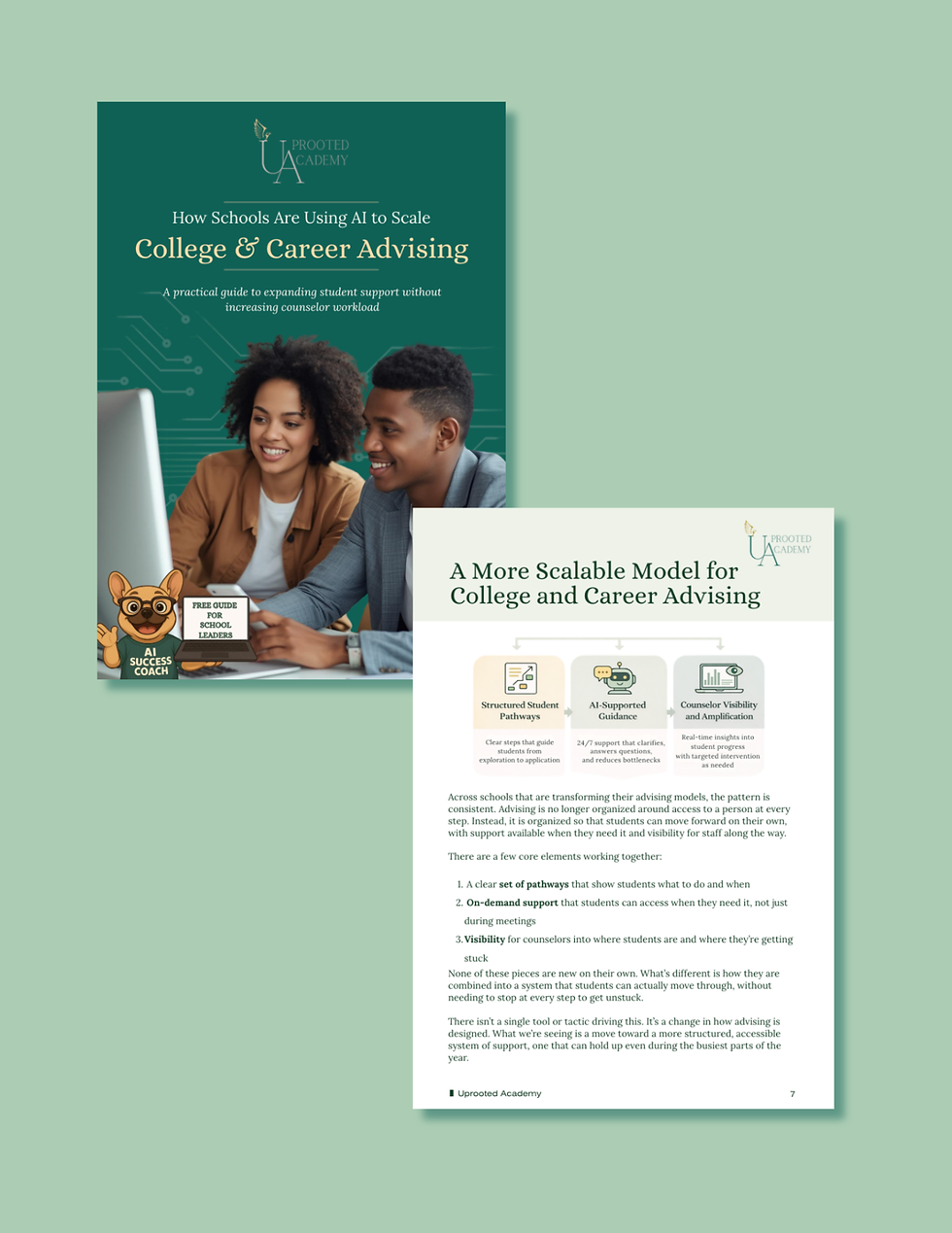
Looking for a more scalable way to support students?
Download the free guide, How Schools Are Using AI to Scale College & Career Advising, to learn:
How schools are redesigning advising to reduce pressure during peak periods
Where AI can expand support without replacing counselors
What to look for in a solution that reduces counselor overload



Comments